Halali Camp: Our full report
Strategically located alongside the middle of Etosha Pan, Halali Resort has its own floodlit waterhole.
One of five erstwhile government restcamps and lodges inside Etosha National Park, it stands beside one of the park's very few hills in Etosha. It's also the smallest and quietest of the original restcamps – although it's still much larger than most camps in Namibia.Like its sister restcamps inside the park, Okaukuejo and Namutoni, Halali in many ways resembles a small village. Along with its chalets and rooms, it has a restaurant, a big swimming pool, a shop and a fuel station – all linked by a small network of roads and footpaths.
As well as a popular camp site, there are 66 chalets and rooms here are split into five categories: two-bedroom family chalets, one- and two-bedroom bush chalets, double rooms, and honeymoon suites. All have air conditioning, lamps, a tea/coffee station and a mini-fridge (which is always empty on your arrival). The beds have mosquito nets above crisp white bedding and very comfortable pillows. In the bathrooms, you’ll find complimentary shampoo, soap, hand and body lotion, as well as soft towels.
- The two spacious family chalets, named Mushara and Sicklebush, are closest to the waterhole. Each has two twin-bedded bedrooms sharing a bathroom, and a separate lounge. There’s also a kitchen equipped with a limited selection of crockery and cutlery, a small oven, a fridge, a kettle and sachets of tea and coffee. Outside is a shaded entertainment area with a built-in braai, a table and chairs.
- Ten two-bedroom bush chalets are smaller than the family chalets, and usually further from the waterhole. There are twin beds in each bedroom, sharing a shower room and separate toilet. The combined lounge-cum-kitchen is not very big but has two sofas, a small fridge, a tea/coffee station, and an assortment of crockery and cutlery. Outside there is a plastic table and chairs, and a built-in braai.
- Ten one-bedroom bush chalets are relatively small but they, too, have a separate kitchen-cum-lounge with a sink, kettle and an assortment of crockery. The bathroom, with a shower and toilet, is very small. These rooms have a sliding glass door that leads to an open patio with a floor of concrete and pebbles. One side of this is screened, so you can sit out at the table and chairs, and there is also a built-in braai.
- The 39 double rooms are each about the same size as a one-bedroom chalet, but lack the kitchen area, patio doors and outside space. The en-suite bathroom in the double rooms is just as small, too, but these rooms do come with an armchair.
- Five honeymoon suites, named after the ‘big five’, are not dissimilar in size to the one-bedroom bush chalets. These, however, have no lounge-cum-kitchen, but there are two armchairs to one side of the queen-size bed. There’s a pleasant skylight above the bed, and behind the headboard that divides the room is an open plan en-suite bathroom with his and her sinks, a shower and toilet. There is also a larger outside area complete with a Jacuzzi.
Halali's swimming pool is one of the best swimming pools that you'll find at any camp in Namibia: very much like a large, open-air municipal pool, however without a lifeguard. Do expect a huge pool; don't expect to have it to yourself!
As at Etosha's other restcamps, one of Halali's big attractions is its floodlit waterhole. This can be viewed at any time of day or night, from a rock terrace which is on one side of the camp.
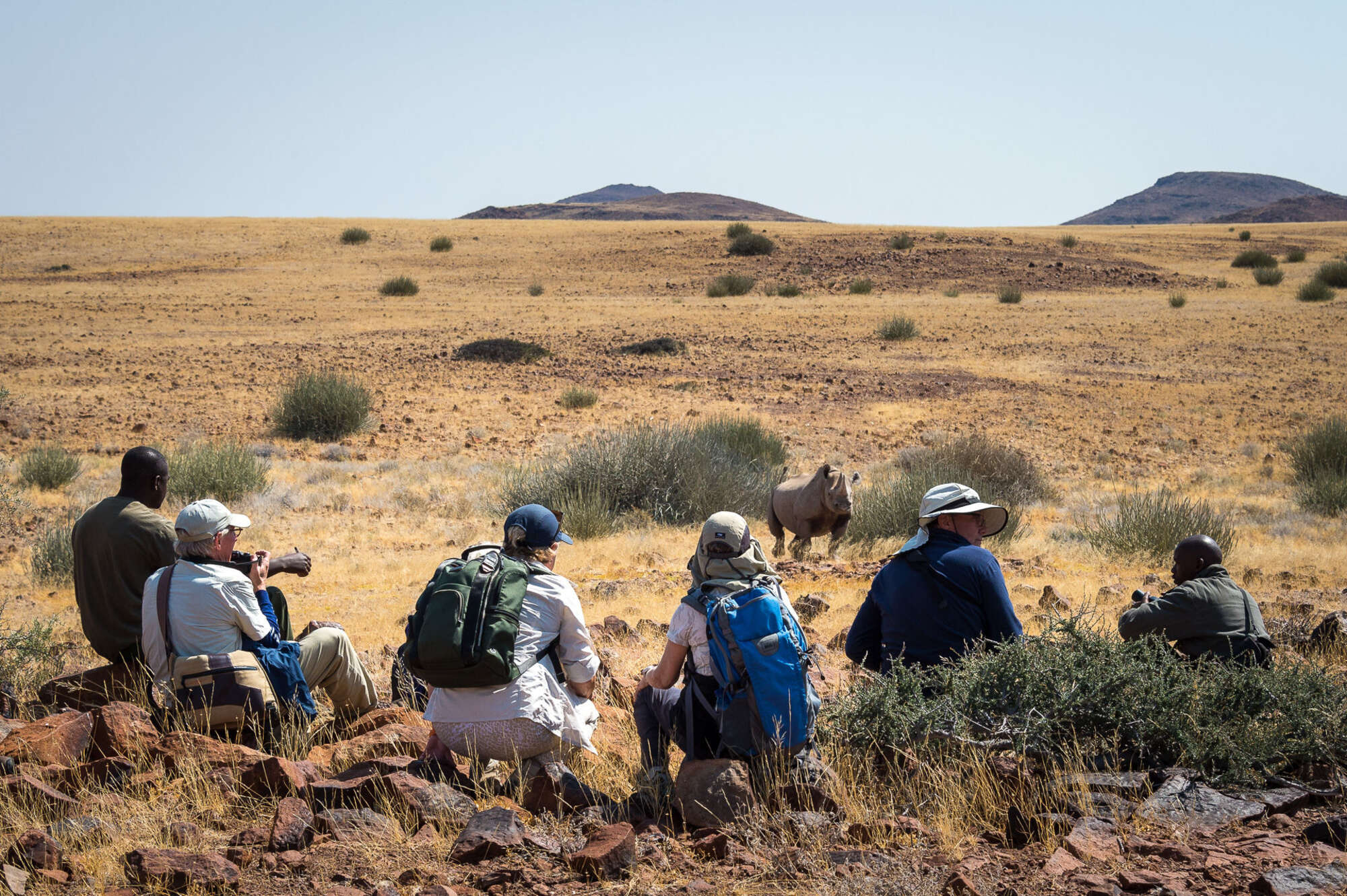
Although the game sightings here aren't quite as predictable as the phenomenal sightings at Okaukuejo, they are generally very good – and particularly notable for black rhino.
Both morning and afternoon guided 4WD safaris are available from Halali, as are night drives – which may not be done by self-drivers. None can be guaranteed, and all must be booked locally, when you arrive at camp, so there is no guarantee of space. It is, however, very easy to drive yourself around the park, as long as you are back by sunset.
Finding space at Halali
Halali often gets booked up in advance, especially in peak season (July to October). Expert Africa holds several rooms throughout this period – usually two-person chalets – reserving them for travellers who visit Halali as part of a fly-drive holiday with us. This means that sometimes we have space at Halali, even when the camp will tell you that they are 'full'.For up-to-date availability information, see Halali's live availability page – and remember that these rooms are only for travellers who book their whole fly-drive itinerary with us.
Our view
As a large restcamp, Halali offers a very different experience from the smaller, private lodges. Don't expect much personal attention here, and the staff are not always as helpful as they might be. Despite this, Halali's amazing location right in the middle of the park, along with its floodlit waterhole, make it a popular and good-value choice.

Namibia expert
Geographics
- Location
- Etosha National Park, Namibia
- Ideal length of stay
- Anything from two to seven nights, but two would be typical, often combined with a few nights at Etosha’s other main camps : Okaukuejo, Namutoni and Dolomite
- Directions
- Halali lies between the two government-run restcamps of Okaukuejo and Namutoni in Etosha National Park, and is well signposted from both. Depending on your routing around the country, the camp can be accessed from either the southern Andersson’s gate or the eastern Von Lindequist gate.
- Accessible by
- Self-drive or Fly-and-Transfer
Food & drink
- Usual board basis
- Bed & Breakfast
- Food quality
- Although we did not eat here on our most recent visit in March 2017, on a previous visit the standards were mediocre. All meals are served buffet-style.
Breakfast is a substantial buffet of different cereals, yoghurts, fruits and cold meats – plus a variety of breads, cheeses and cold meats, and the option of a cooked breakfast.
The restaurant does not serve lunch, but there is a kiosk open during the day, where you'll find basic meals, including toasties and chips.
Dinner is more formal and you can expect the chef to stand in the front of the restaurant preparing the evening meal: anything from a stir-fry to a carvery. For dessert there are normally cakes, pudding and ice-cream.
Many of the chalets at Halali have their own braai (barbecue) facilities, and you can buy wood and charcoal from the camp's shop. Hence many visitors prefer to organise at least some of their own meals here. If you want to do this, we'd advise you to buy food before you enter the park – there's a much wider choice (especially of fresh vegetables) than you'll find at the shops in the restcamps. - Dining style
- Individual Tables
- Dining locations
- Indoor and Outdoor Dining
- Further dining info, including room service
- No
- Drinks included
- No drinks are included at Halali, but there is a cash bar here, and the shop sells a limited amount of alcohol.
Special interests
- Family holidays
- With one of the largest pools in Namibia and a relaxed, family-friendly atmosphere, Halali Camp makes a great stop for those travelling with children in Namibia. Its convenient location within Etosha National Park is an added plus, and it’s relatively economical too.
- See ideas for Family holidays
Children
- Attitude towards children
- Children are welcome with their parents.
- Property’s age restrictions
- There is no age restriction at Halali
- Special activities & services
- The restcamp has a swimming pool and a waterhole that children can enjoy under adult supervision. Children must be over six to participate in game drives organised by the camp.
- Equipment
- On our last visit there was some high chairs for use by children in the restaurant and stretcher-style beds can be added to some of the rooms.
- Generally recommended for children
- Yes – and because the camp is large and fenced, it's better suited to children than many private camps.
- Notes
- Although the camp is fenced, it is large, so there will be vehicles moving around. The pool is also unfenced so all children should be carefully supervised
Our travellers’ wildlife sightings from Halali Camp
Since mid-2018, many of our travellers who stayed at Halali Camp have kindly recorded their wildlife sightings and shared them with us. The results are below. Click an animal to see more, and here to see more on our methodology.

97% success

94% success

94% success

94% success

92% success

82% success

76% success

64% success

38% success

33% success

33% success

10% success

4% success

3% success

3% success

0% success

0% success
Communications
- Power supply notes
- Generator back-up
- Communications
- There is some cellphone reception at Halali, and there is also a public pay-phone, for which you can purchase phone cards from the shop. You can also purchase WiFi vouchers at the reception for use in the central areas.
- TV & radio
- There is no TV or radio in the rooms.
- Water supply
- Mains
- Water supply notes
- The toilets are flush and the showers are plumbed in.
Health & safety
- Malarial protection recommended
- Yes
- Medical care
- The closest doctor or hospital is in Outjo, about a two-hour drive away.
- Dangerous animals
- Moderate Risk
- Security measures
- There are security guards at the restcamp.
- Fire safety
- There is a fire extinguisher outside each chalet/room.
Activities

4WD Safari

Birdwatching

Night drive
Extras
- Disabled access
- On Request
- Laundry facilities
- There is no laundry service here, but there's space to hand-wash items yourself if you need to.
- Money
- Currency exchange is not possible at the restcamp
- Accepted payment on location
- Visa and Mastercard are accepted at the restcamp and no commission is charged.
Other lodges in Etosha National Park
Alternative places to stay in this same area.

Okaukuejo Camp
Set within Etosha National Park, Okaukuejo Resort is a large camp with a productive, floodlit waterhole.

Mushara Bush Camp
The family-friendly Mushara Bush Camp offers great value and is an excellent base from which to explore Etosha National Park.

Ongava Lodge
With fantastic views over a private reserve bordering Etosha, the smart Ongava Lodge offers driving and walking safaris on the reserve, and guided drives in Etosha.

Ongava Tented Camp
Set around a waterhole on a private reserve, the small Ongava Tented Camp combines understated comfort with activities that include walks and night drives.

Onguma Tented Camp
Onguma Tented Camp is a lovely, little tented camp which centres around an attractive waterhole a short drive from the Von Lindequist Gate to eastern Etosha.

Dolomite Camp
Opened in 2011, Dolomite Camp allows visitors access to the far west side of Etosha National Park, which was previously off limits to most visitors.

Mushara Lodge
Close to the eastern entrance to Etosha, the comfortable Mushara Lodge is well-placed for exploring the park in your own vehicle or on a guided drive.

Namutoni Camp
Centred on an old fort, the government run Namutoni Camp is located just inside Etosha National Park, close to Fisher's Pan.

Onguma Bush Camp
For great wildlife viewing without breaking the bank, the affordable and understated luxury of Onguma Bush Camp could be perfect.

Hobatere Lodge
To the west of Etosha National Park, on the edge of Damaraland, Hobatere Lodge offers good game-viewing on its own reserve.

Mushara Outpost
Intimate and luxurious, Mushara Outpost is well-placed on a private reserve to explore nearby Etosha National Park on your own or on a guided drive.

Onguma Camp Kala
For a bird’s eye view across African bush, the stilted rooms at Onguma Camp Kala are truly special.

Onguma The Fort
The Fort is the jewel in the crown of the Onguma lodges, and arguably the whole of eastern Etosha.

Safarihoek Lodge
At the heart of the private Etosha Heights Reserve, Safarihoek Lodge offers comfortable accommodation and excellent game-viewing.

Onguma Forest Camp
From its woodland setting on the Onguma Reserve, Forest Camp is within easy striking distance of Namibia’s flagship national park.

Taleni Etosha Village
Only 4km from Etosha's southern entrance, Taleni Etosha Village is an affordable base from which to explore the park.

Etosha Safari Lodge
A short drive from Etosha National Park's southern entrance, Etosha Safari Lodge is a convenient base from which to explore the park.

Little Ongava
The beautifully located and luxurious Little Ongava is a stunning place to stay in order to explore Etosha National Park and the private Ongava Reserve.

Etosha Safari Camp
Funky, low-key and very original, Etosha Safari Camp is well placed for visiting Etosha National Park on a self-drive or guided safari.

Andersson's at Ongava
With game drives on both its private reserve and in Etosha, Andersson's at Ongava also offers access to the Ongava Research Centre.

Mountain Lodge
In the heart of the private Etosha Heights Reserve, the family-friendly Mountain Lodge offers game drives and bush walks within an exclusive environment.

Mokuti Etosha Lodge
With 106 rooms, child-friendly Mokuti Etosha Lodge is more like a hotel than a lodge. Facilities to include a gym, spa, tennis courts and even a snake park.

Etosha Oberland Lodge
A short drive from Etosha National Park's southern entrance, Etosha Oberland Lodge is a very comfortable base from which to explore the park, with excellent food.

Vreugde Guest Farm
Vreugde Guest Farm is a delightful owner-run and working sheep farm where you can expect a warm welcome and charming hospitality.

Villa Mushara
Offering luxury on a peaceful private reserve close to Etosha, Villa Mushara is a great choice for honeymooners & those wishing to indulge themselves.

Etosha Garden Hotel
Safari in Etosha National Park Namibia, whilst based at the nearby Etosha Garden Lodge.

Etosha King Nehale
A short drive from the national park's northern entrance, Etosha King Nehale Lodge is an interesting and comfortable base from which to explore the park.

Safari House
The private Safari House on the Etosha Heights reserve is a great option families or friends travelling together.


Onkoshi Camp
Onkoshi Camp is owned and run by Namibia Wildlife Resorts. Built on elevated wooden platforms it overlooks Etosha Pan.